Little Miss Back to School Retro SVG
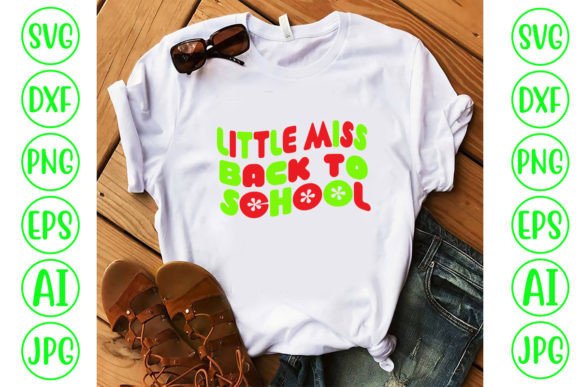
If you're crafting custom classroom decor, designing teacher appreciation gifts, or launching a seasonal merch line for late summer, the Little Miss Back to School Retro SVG is more than just a nostalgic design—it’s a versatile, production-ready digital asset built for real-world use. This isn’t clipart. It’s a layered, multi-format vector package engineered for precision cutting, clean printing, and seamless editing across platforms. But because it’s a digital download only—no physical product included—how you choose, open, and apply it directly affects your final outcome.
What You’ll Actually Get (and Why Format Variety Matters)
Your download includes one .zip file containing:
- 1 Adobe Illustrator (.ai) file — ideal for professional designers who need editable layers, fonts, and vector paths
- 1 SVG file — optimized for Cricut Design Space and Silhouette Studio with preserved grouping and layer integrity
- Word-by-layer SVG files — meaning “Little,” “Miss,” “Back,” “to,” “School,” and “Retro” are each on separate, independently selectable layers. This lets you rearrange, recolor, or hide words without tracing or manual separation
- 1 high-resolution PNG (transparent background) — perfect for digital presentations, social media posts, or mockups where vector tools aren’t available
- 1 EPS file — widely compatible with older design software and print service providers
- 1 DXF file — essential for laser cutters and CNC machines that don’t read SVG natively
- 1 JPEG — useful for quick previews or non-editable sharing
This breadth of formats isn’t overkill—it’s foresight. If you’re using Inkscape or Cricut and assume the SVG will behave the same way in both, you may run into unexpected scaling, missing strokes, or flattened layers. The AI and EPS files preserve fidelity; the DXF ensures mechanical accuracy; the word-by-layer structure saves hours of manual ungrouping.
A Common Misstep: Assuming “SVG” Means “Works Everywhere”
Many buyers download an SVG and immediately open it in Silhouette Studio, only to find text converted to outlines—or worse, missing entirely. That happens when the SVG wasn’t built with universal compatibility in mind. The Little Miss Back to School Retro SVG avoids this by including both standard and word-by-layer SVGs, plus native files for major platforms. Still, always check which version matches your tool:
- Cricut users: Use the SVG file—Design Space reads it reliably, and the word-by-layer version gives you full control over spacing and color per word
- Silhouette users: Prefer the .studio file if offered—but since this package doesn’t include one, the SVG or DXF works best. Avoid opening the AI file directly in Silhouette—it may not render correctly
- Inkscape users: Open the SVG or EPS. Don’t rely solely on the PNG if you plan to resize—the raster image will pixelate
- Print-on-demand or commercial printers: Send the EPS or AI. JPEGs and PNGs lack the vector clarity needed for large-format prints
Skipping this step leads to blurry transfers, misaligned cuts, or mismatched colors—especially if you’re applying the design to vinyl, iron-on, or sublimation blanks.
Overlooking Layer Structure = Wasted Time and Ink
The phrase “word by layer” sounds simple—until you try to edit a monolithic SVG where all letters are fused. With this design, each word lives on its own layer, letting you:
- Swap “Retro” for “2024” or “Kindergarten” without redrawing anything
- Adjust kerning between “Back” and “to” independently
- Apply different foil colors to “Little” and “School” in a single print run
- Isolate “Miss” for a smaller decal while keeping the full phrase intact for banners
Beginners sometimes skip checking layer names before importing. In Cricut Design Space, for example, layers appear in the Layers panel—but only if the SVG preserves them. This package does. If yours doesn’t, you’ll spend 20 minutes ungrouping and renaming manually instead of designing.
What to Verify Before Downloading or Using
Before you click “purchase” or drag the file into your workspace, ask yourself:
- Do I actually need all seven formats? Most hobbyists start with SVG + PNG. Small business owners producing both heat-transfer vinyl and printed posters benefit from having AI, EPS, and DXF on hand—but only if they know how to use them.
- Is my software up to date? Older versions of Silhouette Studio (v4 or earlier) struggle with newer SVG standards. If you’re on legacy software, test the DXF first—it’s more universally stable.
- Will this scale cleanly for my intended use? A 12-inch classroom banner needs vector scalability. A 2-inch keychain charm needs crisp, simplified paths. The Little Miss Back to School Retro SVG maintains clean curves and consistent stroke weights at any size—but avoid stretching the PNG beyond its original resolution.
- Am I clear on licensing? This is a digital download for personal and small business commercial use (e.g., selling handmade mugs or tote bags), but not for resale as standalone digital files or mass-produced apparel lines without extended licensing. Always review the terms included in your download folder.
Why Compatibility Isn’t Just About Software—It’s About Workflow
Imagine preparing back-to-school welcome signs for five different classrooms. With a flat, non-layered SVG, you’d duplicate the file five times and manually change each “Miss” to “Mr.” or adjust grade levels. With the word-by-layer version, you rename one layer once—and copy-paste the updated group across projects. That’s not convenience. It’s consistency, speed, and fewer errors when deadlines loom.
Or picture uploading to a print-on-demand platform like Printful or Gelato. They accept PNG, PDF, and EPS—but not SVG. If you only downloaded the SVG and assumed it was enough, you’d hit a roadblock. Having the EPS ready means you’re upload-ready in under two minutes.
The Little Miss Back to School Retro SVG bridges intention and execution—not by being flashy, but by being thorough. It respects your time, your tools, and your goals. Whether you’re a teacher decorating her door, a freelancer building client assets, or a shop owner stocking seasonal inventory, what matters isn’t just how the design looks—but how smoothly it moves from screen to finished piece.